Integrale 8V - Valves, Valve Seats, Comb.chambers and more

Competition engines and 'live' projects only. Good photos to illustrate your post are expected.
Post Reply
Abarthnorway - Remi L
Posts: 207
Joined: June 24th, 2006, 1:39 pm
Location: Oslo, Norway
Contact:

Integrale 8V - Valves, Valve Seats, Comb.chambers and more

Post by Abarthnorway - Remi L »

Mr. Guy Croft!

I am currently rebuilding a Integrale 8V head after a chipped exhaust valve. In this process quite a few questions and discussions have come to the surface:

1)
Are the exhaustvalves of the Integrale 8V sodiumfilled?
If so are there ways to easily distinguish them from the NA valves?

Please help out here - the discussions have been quite heated....
Even the people that are supposed to know - Like Fiat/Lancia and different engine parts suppliers - wildly disagrees regarding these questions!!
(Btw I ordered some sodium cooled...)

2)
What valve seat contact face width do you recommend for this engine(fast road) running standard boost (1bar) ?

3)
Why has the Integrale 8V head sooo bad finish?
After all its newer and has been redesigned compared to the 130TC`s I usually look at...

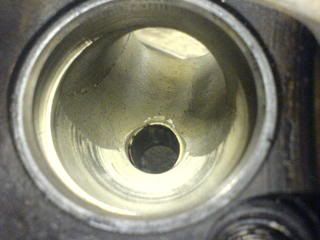
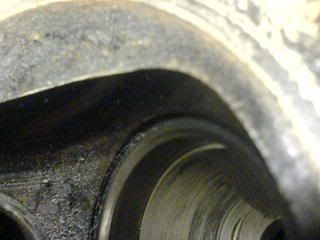
Here are some pics
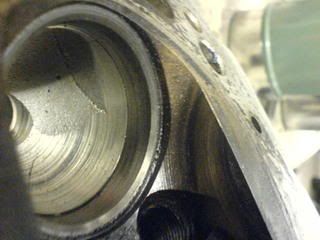
Image Image

Image Image

Image

- Huge edges between seat and valve throat....
- Large flakes of aluminium that rises up in the area of the valve guide... in two ports
- Edge between the cast areas and the machined area of the valve"bowl" are so sharp that they make a real bumps!
- Casting flashes - lots
- A 90` edge rising some places to more than 2 mm over the valve seat.
- General rough finish
- Walls of combustion chamber very close to intakevalves

I`m a bit shocked.......

4)
The Integrale has in its original form an inlet cam with longer duration and higher lift than the exhaust cam. The NA engines all have similar intake/exhaust cams.

What is the real reasoning behind this?

I just cannot understand the argument that this prevents of the high inlet charge from escaping out the exhaust. The high inlet charge comes from the exhaust pressure/energy, and the exhaust ports must therefor be equally or higher pressurised than the inlet side? (at least most of the time...)
In my head the turbo engine is a kind of closed system operating at higher pressure than a normally aspirated one... but in principle operating the same way.

Please explain - I really need to know - I don`t know too much about turbo engines.

5)
A question regarding Oil Consumtion.
By keyholing/modifying the crankshaft as in Your book - will oil consumtion tend to rise as a result of more oil being sprayed up under the pistons?


Thank You very much for Your answers - lovely site!!!
BTW: The head in the pictures is now finished and will recieve a set of GC race guides this week :!:

Last a bragging picture of an intake port before and after:

Image Image

Best regards

Remi Lovhoiden
GC_45
Guy Croft
Site Admin
Posts: 5039
Joined: June 18th, 2006, 9:31 am
Location: Bedford, UK
Contact:

Post by Guy Croft »

HI Remi

Sorry to be so slow.

You asked about a Integrale 8V head rebuild after a chipped exhaust valve.

Q Are the exhaust valves of the Integrale 8V sodium filled?

A Yes, and they need to be.

Q If so are there ways to easily distinguish them from the NA valves?

A They don't have waisted stems.

Q What valve seat contact face width do you recommend for this engine(fast road) running standard boost (1bar) ?

A 1.5mm inlet and ex.

Q Why has the Integrale 8V head so bad finish?
After all its newer and has been redesigned compared to the 130TC`s I usually look at.

A Not for me to judge but probably considered adequate for the job and maybe based on cost reduction. You can find cost-reduction design ideas in many engines if you go back far enough in the lineage.

Q The Integrale has in its original form an inlet cam with longer duration and higher lift than the exhaust cam. What is the real reasoning behind this? The NA engines all have similar intake/exhaust cams. I just cannot understand the argument that this prevents of the high inlet charge from escaping out the exhaust. The high inlet charge comes from the exhaust pressure/energy, and the exhaust ports must therefore be equally or higher pressurised than the inlet side? (at least most of the time). In my head the turbo engine is a kind of closed system operating at higher pressure than a normally aspirated one... but in principle operating the same way.

A Let me first state that we¢ž¢re dealing with a production turbocharged engine and thus if the design power requirement is met in a ‹Å“certain way¢ž¢ the things we might consider doing for ‹Å“tuning¢ž¢ are irrelevant. We can note the following on that OE setup:
The ex valve on a boosted engine can be held closed longer in the power stroke to extract max useful work, the higher cylinder pressure from a boosted engine gives a much more powerful primary ex pulse and thus good cylinder evacuation (reduced pumping loss) without long ex duration. And because we are holding it closed for a longer period we need to use a short duration ex cam or will be held open longer on the overlap phase ¢‚¬Å“ another undesirable thing (again, as I say, where the design power can be achieved without it) because it wastes fuel, even if the high pressure inlet charge blowing across the piston when both valves are open - helps purge the cylinder. A short duration cam can place a very high load on the valve train if the lift is too high, and moreover there is no merit to making the ex valve lift higher than necessary to achieve, again, design power where it is needed. The lower lift ¢‚¬Å“ shorter duration idea is common to pressure-charged engines and on normally aspirated engines you do the same thing too. The very low ex valve lift at TDC is to help inhibit the reverse flow of ex into the inlet manifold on the overlap - needed to a greater extent than a n/a engine because of high back-pressure that always exists in the ex manifold (to drive the turbine). Where a n/a engine needs overlap and lift at TDC, the turbocharged engine will develop high torque with almost none. Compared with a normally aspirated engine the very high torque from the turbocharged unit means we can run quite high gearing and keep the engine speed down and still be quicker.

5)
A question regarding Oil Consumption. By keyholing/modifying the crankshaft as in your book - will oil consumption tend to rise as a result of more oil being sprayed up under the pistons?

No. Absolutely not. For a start the leakage rate thru the bearing is unaffected by the radius mods. Leakage is a function of the running clearance not the shape of the entry & exit holes. All you¢ž¢re doing by oilway mods is reducing the lubricating oil flow loss. The turbo unit has oil sprays to lubricate the pistons and bores of course, oil consumption is no higher because of this than an engine without. Ring and bore condition determines the in-engine consumption and the turbo wastes quite a lot too by allowing oil to be sucked past the compressor-end end seals into the inlet manifold when off-boost.
Post Reply

Who is online

Users browsing this forum: No registered users and 23 guests