Forum for competition engine enthusiasts. RIP Guy Croft 09/11/2020 - This forum will continue both as a source of information and as a memorial to Guy.
That depends on what you want to do with it. If you still want to use it as an engine, you don't want to acid-dip it. The acid will eat at the precision machined surfaces. If it's going to be a purely decorative piece that will never have an engine function, it's probably the easiest solution.
You could put it in an oven and "bake" it for a few hours. I don't know the temperatures they use, but the idea is that you take all the water molecules out of the rust, without distorting the iron. The second step is media blasting. Take some softer material, like walnut shells, the cores of cherries or some plastic stuff. That way, you won't damage the precision surfaces.
I'm told that vinegar (mild acetic acid) is good in those cases.
I use phosphoric acid solution but you have to test first. Mostly however we use wire brushing as on a very rusty VW 16v below, actually quite a satisfying job outdoors on a sunny day*..
G
* when we ever get one on this rain-soaked island
Attachments
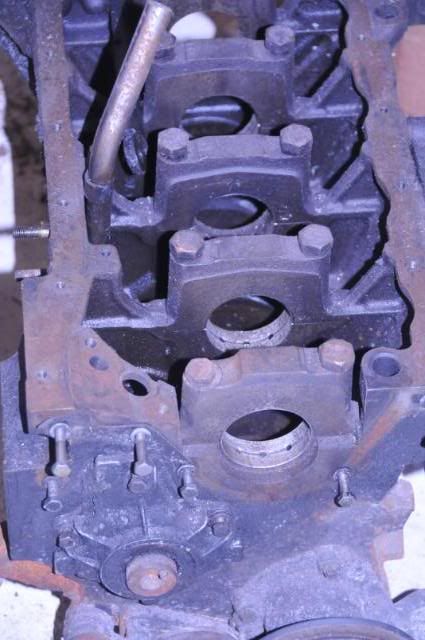
NH 1800 block (18).JPG (66.14 KiB) Viewed 32779 times
NH 1800 block (20).JPG (63.61 KiB) Viewed 32779 times
NH 1800 block (22).JPG (59.93 KiB) Viewed 32779 times
1. The coolant passages are scoured to remove deposits that would impede flow. It is important to get a metal spike down the coolant ports (on the block deck) to break them up - they build up like hard sand.
2. The walls of the cylinders are not severely corroded - you see can the walls thru the same ports and at front-rear of the block. The condition of the old coolant core plugs is always a good indicator.
3. It's cleaned out of the oilways with 'gun brushes' - you have to unplug the oilways to do this and the plugs are still aval (this is covered at length in the book). Oil galleries (drillings) are downstream of the oil filter so the brgs are exposed to anything in them. Cleaning must include the drillings in the journal housings and the vertical feed drillings to the head. If the block is a later type like the Integrale with some of those plugged at the block deck it would be wise to unplug to clean.
4. It's dressed off any functional machined regions - like journal housings, main cap mating faces and areas where gaskets are fitted..
You should try and get rid of any 'flaky' (ie: loose debris) but general light rust (corrosion) won't go anywhere. The new oil and filter will aid the cleaning process once the engine is fired up.
Perform an internet search for "rust removal by electrolysis." An efficient, and frugal method of removing corrosion in hard to reach areas, such as the inner castings of an engine block. Although I am familiar with the process; I cannot comment on the possible, if any, chemical reaction with the auxiliary shaft bearings. Others more knowledgeable in chemistry may know definitively.
You could try an excellent product made by Bilt Hamber (Search online or call 01277 658899) Deox Gel. Not cheap but it comes in various sizes of pots, the 1000 gram tub bieng good value. You degrease the area you want to de-rust and simply brush it on. Brush on 1-2mm of product, leave for 30-60 mins not allowing it to dry then simply wire brush off any brown sludge. Rinse off and dry immediately, if rust remains repeat until clean metal is reached then wash, dry and immediately spray on some corrosion inhibiter (duck oil or similar)
You can't beat acid and a rotary wire brush though, just cover up well won't you?
Better still the same company Dave mentions sell a product call deox-c, which disolves in water and makes a bath of rust removing solution. It is powerfull but totaly safe for ferrous metals, as long as you keep an eye on it every 12 hours or so. One other thing to watch with it is that you must keep the object fully submerged, I found the surface of the solution "eats" a line into the metal for some reason. Once the block is de rusted after usally about 48 hours in cold water ( heated water works in half the time but is a little too viscous imo) the block needs to be put on a stand and jet washed very thouroughly before oiling.
I have some photos but they need re-sizing, once I work that out I'l post them !
Bought some of this the other day and tried it today, to be frank no different from the phosphoric acid solution we normally use but nonetheless quite effective. It does - like all these type solutions - have to be rinsed off with water and not left on too long (or it stains ferrous materials white). Doesn't attack bearings - not if you follow the instructions anyhow. Water-rinse would have to be with some detergent with anti-corrosion additive, else the part will just start rusting again.
I have found that most of the chemicals you can buy to remove rust, have phosphoric acid as their main ingredient. I've tried "Ultra strong tile and bathroom cleaner" with a high phosphoric acid content and it worked just fine. Since it's only a cleaning product and not some form of special motor trade thing, the price is a lot lower. Just look around in your local DIY store and find a cleaning product that has a high phosphoric acid content and make certain it doesn't contain ingredients that could hurt your iron. Try on something not worth saving anyway to see if it does the job, before you put your precious parts in there.